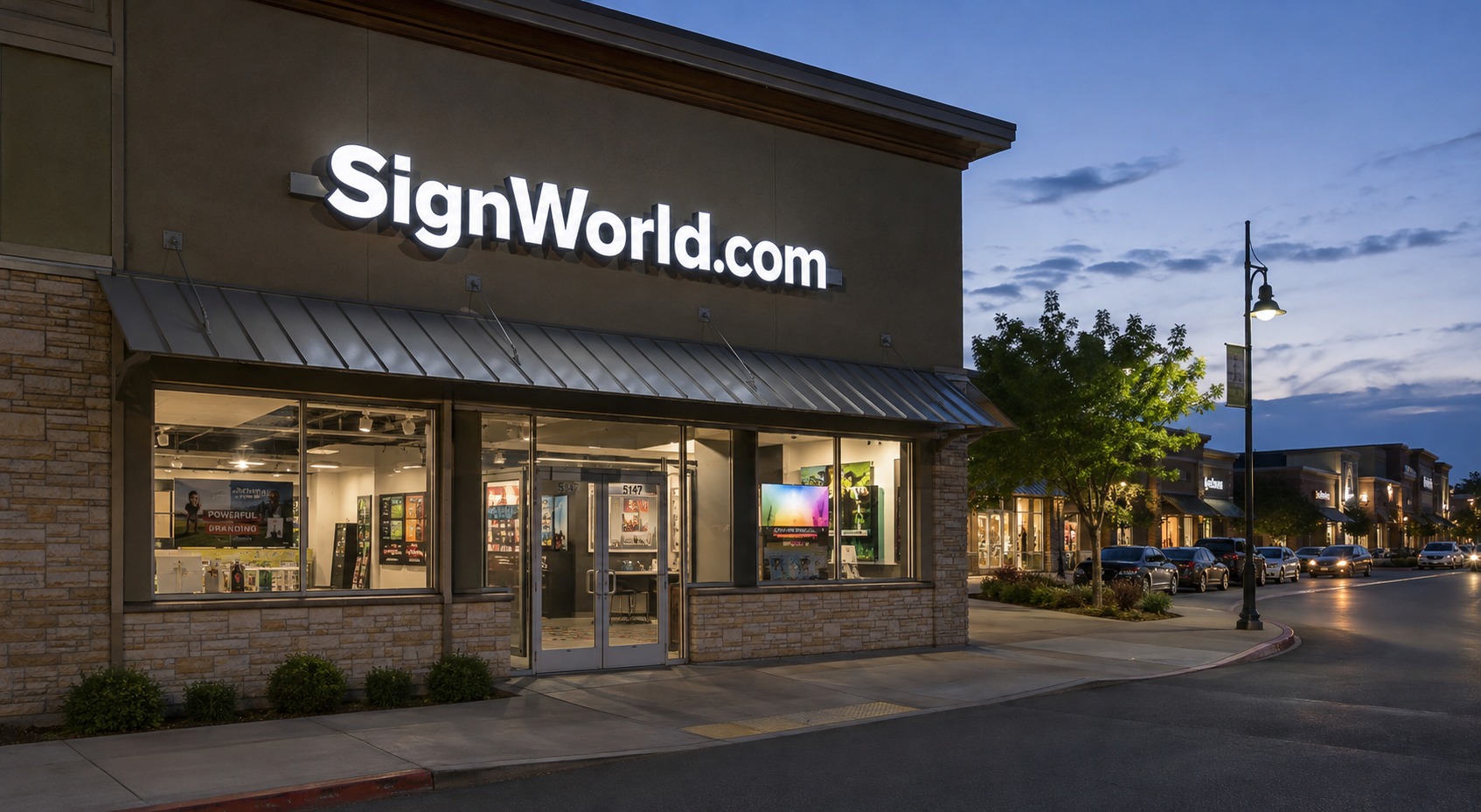
I see SignWorld.com first as the name above a serious sign company with reach beyond one town. Many good shops are named for a founder, a county, or the city where the first truck was parked. Those names can serve a local business well. They become harder to carry when the company buys another shop, enters a new state, or begins serving customers with hundreds of locations. SignWorld sounds like the category, which gives a growing operator a common banner from the start.
The idea is not a loose franchise directory. I would build an operating brand with clear standards for surveys, design, fabrication, permitting, installation, and service. A restaurant group opening in five states should encounter one project language and one accountable team. Regional production could remain close to the work, while the customer experience, quality checks, and reporting stay consistent. The International Sign Association shows how broad the field is, covering manufacturing, installation, codes, safety, and business education. A national brand has to respect all of those disciplines.
One name over regional strength
I would begin with a small group of excellent shops whose capabilities complement one another. One may be strong in channel letters and cabinets. Another may know complex monument structures. A third may have field crews positioned for national retail service. The point would be to preserve practical expertise while giving customers one way to request work, approve drawings, follow permits, and see completion photos. Central coordination should remove friction without flattening the judgment of people who know local buildings and code officials.
Production technology can create a shared baseline. Events and training from PRINTING United Alliance reflect the overlap between wide-format print, finishing, installation, and sign production. A SignWorld operating system could translate that overlap into repeatable specifications. Color files, substrates, illumination, mounting details, access needs, and landlord criteria would be collected before a job reaches the floor. Better inputs protect margins and reduce expensive return trips.
The customer promise would stay concrete: accurate surveys, buildable drawings, clear schedules, safe installations, and dependable service after the sign is lit. I would resist broad claims about being everything to everyone. National customers value coverage, but they also remember missed openings and inconsistent sites. The brand earns its scale one location at a time. A simple dashboard and named project lead would matter more than a grand corporate line.
A visible standard
The strongest launch market may be multi-location storefront programs. Channel letters, window graphics, code signs, awnings, and blade signs create a manageable package with frequent repeat work. The annual ISA International Sign Expo is a useful view of the equipment, materials, software, and relationships behind that work. I would use those industry connections to qualify capacity and find regional partners, not merely to assemble a long vendor list.
I learned a related lesson after founding i-Newswire.com in 2007 and later working through iNewswire.com. Customers did not experience a platform as a collection of internal departments. They experienced the promise made at the front door. As Newswire.com grew, the clearest gains came from making that promise easier to understand and then improving the systems beneath it. SignWorld would need the same alignment between the name customers remember and the work crews deliver.
A national sign company also needs a credible service model. Illumination fails, storms damage faces, tenants change, and property teams cannot wait for a new procurement exercise each time. Established operators such as YESCO demonstrate the lasting importance of maintenance alongside fabrication. I would make service history part of every location record, with photos, access notes, component details, and warranty dates ready for the next call.
How I would test it
I would start in one corridor with a limited set of customer types and partners. The first measure would be repeatable delivery, not map coverage. Can the team survey five locations the same way? Can drawings move through landlord and municipal review without avoidable resets? Can a project manager give an honest status without chasing several inboxes? If those answers are solid, the territory can widen with confidence.
SignWorld.com gives that plan a name with unusual visual authority. It can sit on a fascia, a truck, an installer badge, or a national proposal and still say exactly what field the company serves. My role would be to protect the clarity of the brand while experienced sign people shape the operation. For the right buyer, the domain can become the shared identity above an existing network. For the right partner, it can be the starting point for building that network carefully.