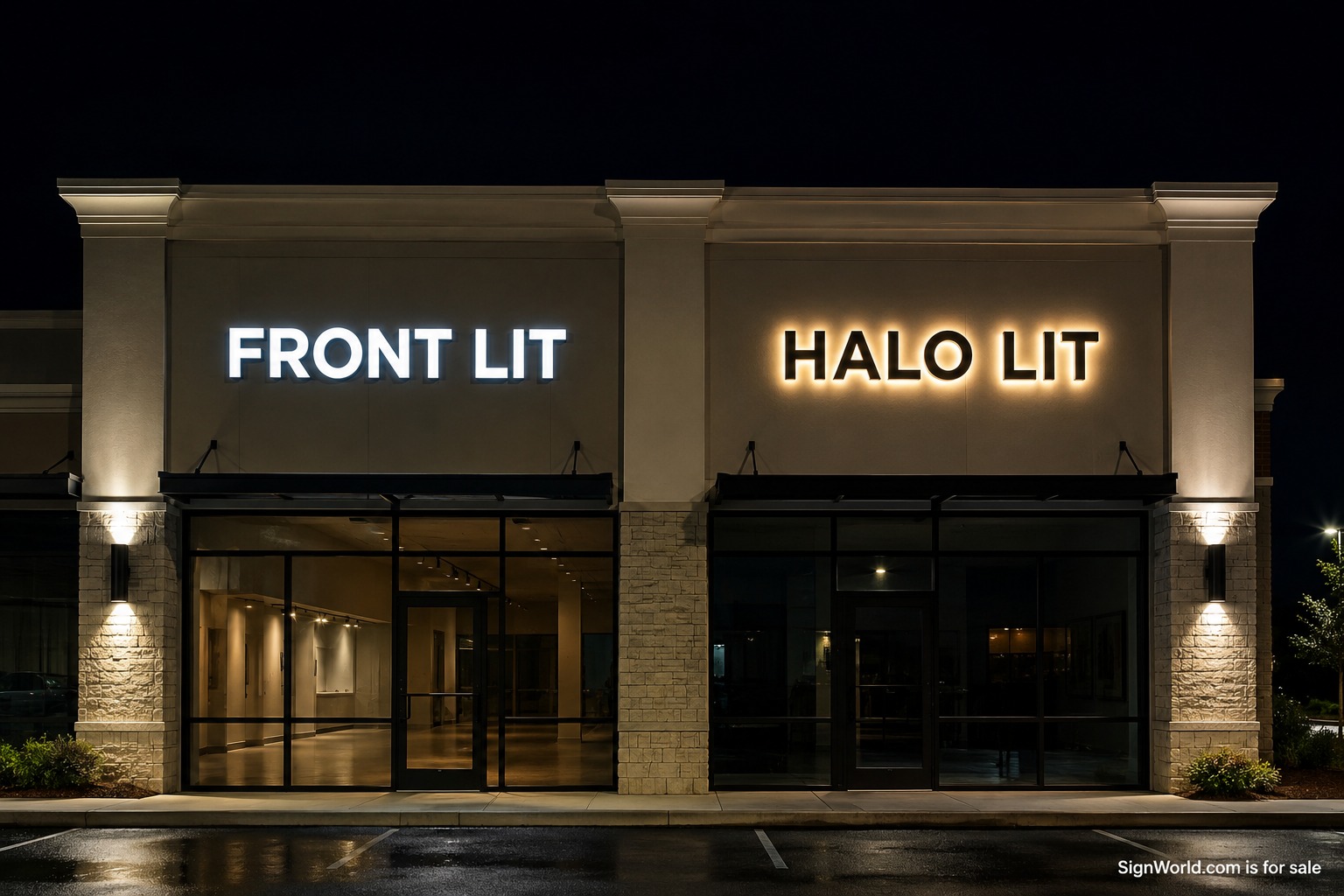
Front-lit and halo-lit channel letters can carry the same logo, use similar aluminum construction, and contain LED modules, yet they behave very differently on a building. Front-lit letters send light through an acrylic face toward the viewer. Halo-lit letters, also called reverse-lit letters, send light toward the wall and create a glow around an opaque face. The right choice depends on viewing distance, wall material, brand tone, landlord rules, maintenance access, and the amount of contrast available after dark.
A front-lit letter usually has an aluminum back and return, internal LEDs, and a translucent acrylic face held by trim cap. The bright face reads directly from the road. A halo-lit letter often has a metal face and returns with a clear or open back. Stand-offs hold it away from the wall so reflected light forms the halo. Some sets combine both methods. The FASTSIGNS channel-letter overview provides a useful visual starting point for the common constructions.
Start with the viewing condition
Front-lit letters usually win when the storefront must be found quickly from a moving car, across a large parking field, or among several neighboring signs. The illuminated face offers a larger bright area. Letter height, stroke width, spacing, and background contrast still matter. More light cannot rescue a compressed wordmark or thin type viewed from too far away. Ask the sign company to place scaled artwork on a straight elevation and on an angled site photograph before approving the set.
Halo lighting is often effective at closer distances where the wall can become part of the composition. The glow separates a dark or metallic face from the surface and gives the letters depth. It can feel controlled and architectural, especially on stone, smooth stucco, or an opaque panel. The comparison from Signs Manufacturing shows how face illumination and reflected illumination change the nighttime impression.
The wall decides more than the rendering
A halo needs a surface that reflects light with some consistency. Smooth, light-colored walls tend to create an even outline. Rough stone, deep mortar joints, corrugated metal, glossy tile, and heavily varied brick can break up the glow. That does not always look bad, but it should be expected. A night test with one sample letter is valuable when the wall is unusual. The stand-off distance and LED placement can be adjusted, but they cannot make every surface behave like white stucco.
Front-lit letters are less dependent on wall reflectance, though the background still controls contrast. White faces on a pale fascia may disappear during the day. Dark returns or a backing panel can restore definition. Halo-lit letters need adequate space behind the letter for wiring and light spread. Both types require a mounting plan that accounts for structure, weather sealing, drainage, and electrical access. A pretty elevation is incomplete until a qualified installer has considered what is behind the finish.
Raceway, direct mount, or backer
Individual letters can be mounted directly to the building, with wiring passing through the wall to remote power supplies. This creates a clean appearance but may require many penetrations and interior access. A raceway collects letters and electrical components on a narrow metal cabinet. It can reduce wall penetrations and simplify service, though the raceway remains visible. A backer panel can create deliberate contrast and conceal difficult wall conditions. Landlord sign criteria often determine which methods are permitted.
A careful buyer should request a mounting detail, not only a front elevation. The guide from Graphics 22 Signs discusses construction and mounting choices that affect the finished set. Confirm letter depth, face and return colors, trim, stand-off distance for a halo set, raceway dimensions if used, transformer access, disconnect location, and patching responsibilities. These details help a landlord, electrician, sign shop, and general contractor coordinate before installation day.
Compare cost by scope, not one number
Channel letter pricing changes with total letter count, height, depth, logo shapes, dual illumination, paint, mounting method, access equipment, engineering, permits, and travel. A small set on a one-story fascia is a different project from tall letters installed above a busy street. Ask each bidder to state what is included: survey, design, sealed drawings, permits, fabrication, electrical connection, lift or crane, traffic control, installation, cleanup, and warranty. A low fabrication number can become an expensive project when those items appear later.
The cost discussion from BlinkSigns can help identify variables to raise with a local shop, but a site-specific survey remains the useful basis for a quote. Compare the same letter size, illumination, materials, mounting, and service scope. Also ask whether the electrical connection is performed by the sign contractor, a licensed electrical subcontractor, or the tenant’s electrician. Responsibility should be clear in writing.
Color, dimming, and night rules
Acrylic face color changes between daylight and illumination. Printed brand standards may not translate directly to translucent material, and some colors wash out when LEDs are too cool or too bright. Request day and night samples for important colors. Halo illumination has its own choices: warm white may suit masonry and hospitality, while cooler white can feel crisp against metal or painted panels. Local rules or landlord criteria may limit color, brightness, operating hours, animation, and exposed raceways.
Dimming can be valuable when a sign faces residences or sits in a refined mixed-use project. Specify dimmable power supplies at the start rather than treating them as a late correction. Timers or photocells should match the property’s operating plan. Inspect the sign after surrounding exterior lighting is on. A set that looks balanced in a dark shop test may compete with parking-lot poles, canopy lighting, and neighboring tenants at the actual site.
Plan for service
LEDs last a long time, but modules, power supplies, faces, seals, and wiring still need attention. Ask how technicians will reach the letters and where components are housed. A raceway can make power supplies easier to service. Direct-mounted letters may offer a cleaner wall but require interior access or more involved removal. Record paint codes, acrylic colors, module specifications, power-supply models, permits, approved drawings, and final wiring photographs in the property file.
Choose front-lit letters when direct nighttime readability and a bright face are the main goals. Choose halo-lit letters when the wall is suitable and the brand benefits from dimensional, reflected light. Consider a combination set when both effects serve a real purpose and the code permits it. The final decision should come from a nighttime viewing plan, a verified wall condition, a complete mounting detail, and a quote that accounts for the whole installed project.